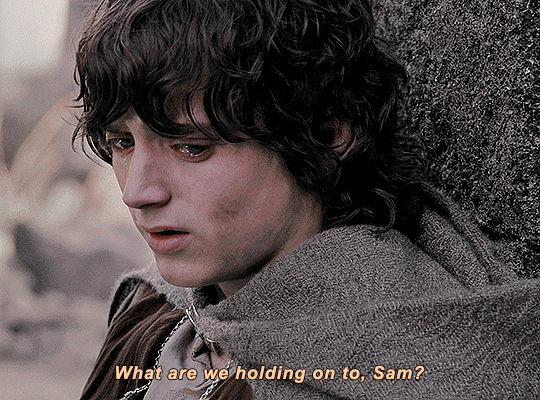
Open your favorite news app or scroll any social media platform and you’ll find messages of uncertainty, instability, overwhelm, anger, and despair. And for me, one question has been looming quite large: “How do we move forward with hope?”
I was listening to a recent episode of the Pivot podcast with Kara Swisher and Scott Galloway. Their guest that episode was one of my absolute favorites – Brené Brown, research professor, University of Houston. During a very thoughtful conversation on loss and regaining one’s discernment, Brown said:
“Hope is not an emotion. It’s a cognitive, behavioral process.”
Wait. What?
I have noted times in my life when I felt incredibly hopeful. I said those words, “I feel hopeful.” And I’ve had moments of deep despair, feeling overwhelmed and where I felt like there was little to no hope. So, again: how is hope not an emotion?
The Elements of Hope
Luckily, Brown went on to explain and provide further context. She referenced the work of C.R. Snyder and his Hope Theory. C. R. Snyder was a luminary in the field of psychology who dedicated his life’s work to unpacking the construct of hope. Cool, right?
Snyder put forth a theory of hope, which basically says that hope is made up of 3 core elements:
- Goals
- Pathways
- Agency
Goals being the “What”. They are the attainable aspirations and clearly articulated targets we aim to hit.
Pathways are the “How”. They are the routes we map out in order to reach those goals. But this is the interesting part: in Snyder’s studies, he found that people with the most hope are those able to see and attempt multiple ways forward when they hit a roadblock. If their main plan for reaching their goal(s) doesn’t work, they move on to their back-up plan, or their back-up to the back-up plan, or their back-up to the back-up to the back-up plan until, finally, they achieve their goal.
In short, those found to be the most hopeful are able to adapt according to changing obstacles on the road to “success”. (I put success in quotations because success is relative but that’s a different post).
Agency, in this context of the Hope Theory, is the ability to believe that you can cultivate change and influence your outcomes. It is the driving force within us that helps us press forward in the face of difficulty, while also fostering resiliency.
I think an important point to make here is that agency should not be confused with control. There will always be things outside our control, just as there always have been for everyone, everywhere, at every time in history. Still, you can affect change. You can’t control the movement of water in a lake, but you can create ripples by jumping in.
Believing in your ability to overcome obstacles and create change is key to sustaining hope in challenging times.
Out of the 3 elements, agency is where people sometimes get tripped up. And it’s a lack of agency that can greatly affect our ability to hope. This is exactly what Brené Brown, PhD, MSW proposed in the podcast.
The Modern Crisis of Agency
When we look at the world around us – our current political climate, a volatile job market, economic turmoil, climate change, rapidly changing technology, financial strife, greed run amok, and global crises – it can all feel like too much. We feel stripped of our agency and the ability to create any kind of change, thanks to forces beyond our control.
In short: we feel small.
And there is a psychological impact this loss of agency is having on us as a global community. This erosion of agency can lead to despair, making hope seem like a mirage.
According to the Second Law of Thermodynamics, entropy – chaos, disorder, uncertainty – is always increasing. The chaos in the universe today will be even greater and less predictable tomorrow. We can’t change that, even if we try. Another thing outside our control.
But I don’t think that is cause for despair. In fact, I think it’s an opportunity to strengthen our resilience and reclaim our own agency.
How can we do that?
Striving to Restore Agency
I think regaining agency begins with small, deliberate actions. Because, honestly, that’s all we have.
1. Start by setting up good systems. In Atomic Habits: An Easy & Proven Way to Build Good Habits & Break Bad Ones, author James Clear states, “You do not rise to the level of your goals. You fall to the level of your systems.” Goals are what you want to achieve, while systems are the small but achievable steps you take to build momentum and reach those goals. If you haven’t yet read Atomic Habits, get on that. It has some great tips for building better habits that will leave you feeling empowered instead of overwhelmed.
2. Cultivate adaptability. I hate the phrase “roll with the punches” just from a wording standpoint, but the advice is solid. So, here I am, using it. In a world of constant change, our ability to pivot and persevere may be our greatest asset. Something doesn’t work out? Learn to let it go and look for the next way forward.
It’s hard to admit that the route you had planned on has become impassable and now you need to try something different. But it’s worse to stick with something that clearly isn’t working simply out of stubbornness or fear.
3. Finally, cultivate mindfulness. Pay attention to your thoughts and the way you speak to yourself. Notice the words you use when speaking, even internally, about your goals and what you want in life.
“What’s the point?”
“No one will notice.”
“What good will it do?”
“I’m not important enough. It doesn’t matter anyway.”
Those are thoughts that get in the way of your agency. And they’re bullshit.
Because it matters a great deal what we do, even if no one notices. It also matters what we do, even if it seems the amount of good being done is too small to measure.
“It’s just a drop in the bucket, so what does it matter?”
Okay. But:
“What is an ocean but a multitude of drops?”
– David Mitchell, Cloud Atlas
Getting to Paris (This Will Make Sense In a Second)
Goals. Pathways. Agency. According to Snyder, each is essential for a hopeful mindset.
I think that’s an incredibly helpful way to look at building and maintaining hope, but…I think it’s missing something crucial.
Acceptance.
Before you can map out where you want to be, you have to know and accept where you are.
One of my best friends has this great metaphor. Let’s say you want to go to Paris. Who doesn’t? But right now, you are in Chicago. Nothing wrong with Chicago (again, this is a metaphor so please don’t come at me, Windy City residents), but it’s not not where you want to be.
So you book a flight from Chicago to Paris. Right? You wouldn’t book a flight from NYC to Paris since that’s not where you will be starting your journey. No matter how much you love NYC, a flight out of NYC won’t be helpful since you are in Chicago.
So why would you build a plan for achieving your goals that starts, not from where you are now, but from where you wish you were?
I understand feelings of disappointment or possible shame around where you are in life and wanting it to not be so. You may wish you were further along in achieving your goals or simply long for an easier path forward. But you have to accept where you are now, not where you would prefer to be. Otherwise, you are setting yourself up to fail.
You can still get to Paris from Chicago! It just requires a different travel plan.
Final Thoughts
We live in very turbulent times. Uncertainty seems to shadow every step we take. ENtropy is increasing. We are all searching for glimmers of hope that can pull us through the darkness.
But hope is not a mere wish waiting to be granted if only you say the magic words.
It’s a powerful, actionable tool that helps propel us forward.
It takes work to cultivate hope. But when we do, it can help us navigate the roughest roads and the darkest nights.
Because hope is not an emotion. It’s a lighthouse.
How do you cultivate hope in your life? Share your stories and strategies in the comments below. Let’s inspire each other!
References:
1. Snyder, C. R., Rand, K. L., & Sigmon, D. R. (2002). Hope theory: A member of the positive psychology family. In C. R. Snyder & S. J. Lopez (Eds.), Handbook of positive psychology (pp. 257–276). Oxford University Press. https://teachingpsychology.wordpress.com/wp-content/uploads/2012/02/hope-theory.pdf
2. Clear, James. Atomic Habits: An Easy and Proven Way to Build Habits and Break Bad Ones. Penguin Random House, 2018, pg.
3. 2nd Law of Thermodynamics. LibreTexts, Chemistry. https://chem.libretexts.org/Bookshelves/Physical_and_Theoretical_Chemistry_Textbook_Maps/Supplemental_Modules_(Physical_and_Theoretical_Chemistry)/Thermodynamics/The_Four_Laws_of_Thermodynamics/Second_Law_of_Thermodynamics
 Casey Moeckel
Leave a comment