This week marked the 10th anniversary of Hamilton’s Broadway debut. To celebrate, the original cast reunited and lit up the Tonys with an electric medley of songs. If you haven’t watched it yet, do yourself a favor and fix that. I’ll wait.
(I’ve already watched it five times. Don’t judge me, or do.)
Earlier this year, I finally read Ron Chernow’s Hamilton, the biography that sparked Lin-Manuel Miranda’s lyrical revolution. It’s a brilliant, albeit dense, portrait of a flawed genius who believed – perhaps above all – in building systems strong enough to outlive him.
But between singing along to the Hamilton soundtrack and dog-earing pages of Chernow’s book, I’ve been thinking a lot about legacy. What we build, what we leave behind, and just how easily all of it can be undone.
Because reading that book in the shadow of today’s headlines left me with questions I can’t shake:
What happens when the systems we once trusted start to buckle? What happens when the very foundation Hamilton helped lay starts to crack under the weight of our own apathy?
Legacy isn’t just about what we build: it’s about whether what we build can withstand time, distraction, and deliberate attack. And right now, the structures we were told would hold are showing hairline cracks.
Enter the Hollow Men
“Shape without form, shade without colour,
Paralyzed force, gesture without motion.”
— T.S. Eliot, “The Hollow Men”
That’s from T.S. Eliot’s poem, The Hollow Men. Written in 1925, it’s a haunting reflection on the despair, apathy, resignation, and spiritual paralysis that follow in the wake of a collapsed faith—not just faith in the divine, but faith in institutions, leaders, and even purpose itself.
Today, that same hollowing out is echoed in our growing distrust of government systems and absent leaders.
But the universe abhors a vacuum. And so, when civic faith and public trust in our institutions disappeared, cynicism and grievance swooped in to take their place. That was quickly followed by something even more dangerous.
Fascism doesn’t just thrive in the absence of faith; it replaces it.
It offers false certainty where democracy offers debate.
A powerful quote from Hamilton that speaks directly to the void where fascism can take root is in “Aaron Burr, Sir” when Alexander challenges Burr by saying:
“If you stand for nothing, Burr, what will you fall for?”
In just one line, Miranda captures the danger of disengagement (even if just for personal gain or self-preservation). When the bedrock of democracy—our willingness to stand for something—is hollowed out, the stage is set for something far more destructive.
The Room Where It Starts
So what does fascism look like in the 21st century? (You already know, but let’s talk about.)
It’s a spectacle of vengeance-fueled governance meant to keep you in fear, while demanding your complete and unquestioning obedience.
It’s the deliberate escalation of unrest, not to restore order, but to justify crushing it.
It’s politicians who perform their patriotism but absolutely despise the participation of the people.
It’s fear draped in nostalgia from the “make it great again” types trying to sell you a vision of the past that never quite existed and definitely never included all of us.
It’s the dehumanization of communities and yours might be next.
Alexander Hamilton warned us of this in Federalist No. 1, saying:
“Of those men who have overturned the liberties of republics, the greatest number began their career by gaining the confidence of the people… to betray them.”
He knew that America’s greatest threat wouldn’t come from a foreign fleet sailing swiftly in on the Potomac; it would be a threat coming from inside the house. He saw the seeds of tyranny being sown in demagoguery, apathy, distraction, and the acceptance of charismatic grifters who think they’re above law.
The Room Where Democracy Doesn’t Happen
Democracy is supposed to happen in rooms where voices are heard, debates are real, and the structure of checks and balances is upheld. But more and more, those rooms feel performative and empty of any real participation. Sure, the rituals remain, but the substance is gone.
When you think about the destruction of a democracy, don’t think about a 6.0 earthquake that quickly levels buildings or a barrage of cannonballs exploding to a swelling musical score.
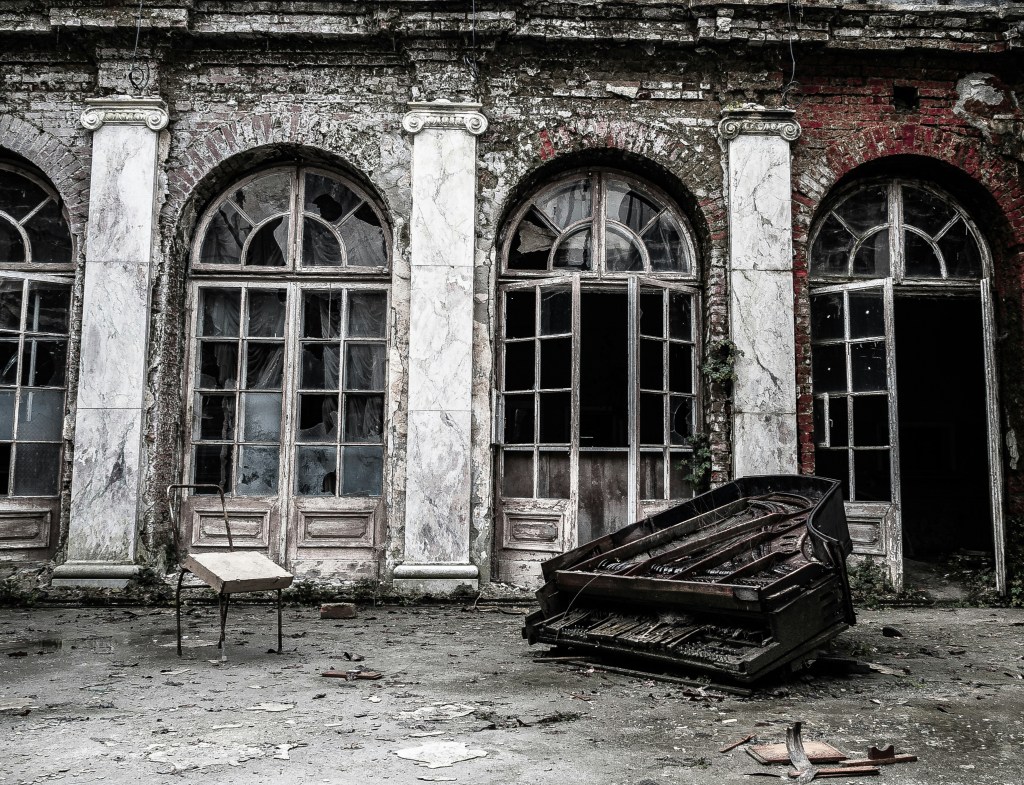
Think of a once-grand hall left to gather dust: the ceilings crack, the foundation settles, and the walls crumble inch-by-inch while no one even bothers to look up.
Silence and neglect doing what brute force never could.
The room doesn’t collapse all at once. It decays in layers with the steady erosion of democratic systems, the vilifying of our free press, the dismissal of scientific research, the mocking of domain experts, the ousting of civil servants, and the deliberate invention of enemies to justify it all.
For fascism to succeed, it doesn’t need to loudly conquer a nation; it just needs us to stop taking care of it.
Like that plant in the corner of the living room that you forgot to water and now it’s just a dried husk.
To take another line from Eliot’s The Hollow Men:
“This is the way the world ends / Not with a bang but a whimper.”
Sometimes the whimper sounds like a full-blown car advertisement on the lawn of the White House. Or an announcement of a meme coin wrapped in a flag. A public tantrum because a legendary rock star hurt his feelings. A public meltdown between a “”leader” spouting strongman rhetoric and a billionaire high on ketamine that’s so unhinged it feels like a Bravo special.
It’s so much that you can’t keep up, let alone process it. Because rent’s due, you’re running late to work, and you’ve already gotten eight breaking news alerts since rolling out of bed. So you move on and the erosion continues.
That’s how straw men stuffed with grievance and false grandeur creep in.
Say No to This (Kind of Governance)
You remember that scene in the original Jurassic Park, when Dr. Grant, Dr. Sattler and Dr. Malcom check out the velociraptor enclosure and the game warden explains that the raptors have been systematically testing the fences for weaknesses?
It’s that. Only now the raptors are elected officials and they’ve brought wire cutters.
They’re done testing the fences. They are tearing them down and wreaking havoc – all while having the audacity to call it governance.
Meanwhile, the rest of us are told to stay civil. Don’t rock the boat or else they’ll send in the National Guard.
History Has Its Eyes on Us
American democracy is not a naturally occurring mechanism. The America that Alexander Hamilton and the rest of our Founding Fathers built wasn’t inevitable after the revolution.
It took effort to build and it takes effort to preserve. That means constant vigilance over our checks and balances, the continual consent of the governed, and a million small acts of engagement that a healthy democracy demands, like:
- Reading bills before we believe headlines or talking heads.
- Voting in every election, not just the big ones.
- Calling out lies before they calcify into “common sense.”
- Refusing to let cynicism become our national religion.
This is the moment when we stop scrolling and start standing. Because history doesn’t just have its eyes on us—it’s waiting for our next move.
And if we don’t show up, someone else will write the ending.
Maybe legacy isn’t the shining thing we leave behind. This time, maybe it’s the thing we keep from collapsing.
 Casey Moeckel
Leave a comment