A nation doesn’t lose its ambition overnight. It happens when we stop funding the work that carries it forward.
On June 25, NASA leadership confirmed in a Town Hall what had already started to circulate: that the agency’s FY2026 budget is facing a 24% cut, with the Science Mission Directorate alone reduced by nearly half, going from $7.3 billion to $3.9 billion (1, 2, 3). It’s the steepest rollback of public science funding in NASA’s history.
These aren’t just numbers. These cuts would cancel 19 active missions and jeopardize over 40 more, including (4):
- Mars Sample Return (the most ambitious planetary science mission in NASA’s history)
- Nancy Grace Roman Space Telescope (our next major observatory, designed to study dark energy)
- Chandra X-ray Observatory (one of NASA’s four Great Observatories, essential for studying black holes)
- VERITAS, a long-awaited mission to map Venus and unlock the mysteries of our planetary neighbor.
More than $1.5 billion would be slashed from Earth and climate science. And NASA’s civil servant workforce would shrink by a third, taking us back to staffing levels not seen since before human spaceflight. Let that sink in.
Public science gets gutted while private space gets a launchpad. Apparently, in this timeline, shared fiscal sacrifice means NASA loses billions while billionaires get to deduct their space toys.
NASA’s rollback isn’t just a budget issue. It’s a crisis of imagination, democracy, and direction.
And here’s what most people don’t realize: the scientists and engineers who work on these missions can’t publicly advocate for their funding. NASA employees are civil servants and are legally prohibited from publicly lobbying Congress.
So if anyone’s going to fight for it, it’s us.
I tried for years to join NASA’s public affairs team. I think I even got close. In the end, it never worked out and I cried when the current administration announced how they would be gutting the agency.
I’m not on the NASA team, but I still believe in the mission. That’s why I’m writing this.
What We Lose When We Lose Science
This isn’t just about rockets or research. It’s about what we lose when we lose science.
- We lose the climate models that warn coastal communities when to evacuate ahead of hurricanes—data made possible by satellites like Landsat and instruments like AIRS and CERES.
- We lose the space weather forecasts that protect our power grid, GPS systems, and aviation networks—research driven by missions like DSCOVR and the Solar Dynamics Observatory, both now on the chopping block.
- We lose the GPS infrastructure that hundreds of millions of people rely on every day: from drivers and delivery fleets to agriculture and emergency services. A major GPS outage could cost $1 billion per day, disrupt commerce, banking, power systems, and hamper disaster response. (5)
- We lose the innovation pipeline that gave us MRI machines and a thousand other things that quietly power our daily lives.
You know what else we lose when we lose science? We lose curiosity. We lose leadership. We lose the will to imagine more.
“What’s next?”
That was President Bartlet’s signature line on The West Wing—part catchphrase, part credo.
It wasn’t just a way to end a meeting, but also a philosophy: that progress is a choice, one we have to keep making. That we don’t stop moving just because it’s hard.
I believe to be human is to explore; and to explore is to insist there’s always more to become. Change is constant: we can’t always predict it, but we know it’s coming. The only brave thing to do is meet it head-on.
“Cause it’s next. ‘Cause we came out of the cave, and we looked over the hill and we saw fire; and we crossed the ocean and we pioneered the west, and we took to the sky. The history of man is hung on a timeline of exploration and this is what’s next.” – Sam Seaborn, The West Wing
These budget cuts to our greatest public institution for scientific research and exploration are not a coincidence.
They represent a deliberate move towards the privatization of space exploration, shifting power from public institutions to private companies owned by billionaires with no public mandate (Space X owned by Elon Musk, Blue Origin owned by Jeff Bezos, and whatever company owned by the billionaire who wants to get in the game next. Maybe Sam Altman will do SpaceGPT?).
That’s not exploration, that’s consolidation. The next breakthroughs will still happen, sure, but fewer people will benefit. Because they’ll be behind paywalls and locked in patent portfolios.
The bottom line is you don’t gut exploration unless you’ve already decided to stop dreaming. Or…. you’ve decided someone else should own the dream (and get a tax write-off for it).
Meanwhile, the U.S. hands over its scientific edge, hollows out its innovation economy, and weakens its climate readiness. Not because we couldn’t afford to invest. But because we didn’t care enough to.
And maybe that’s the point. No, actually, I am sure that is the point.
These science cuts aren’t just fiscal. They’re political.
An uninformed public is easier to manage. Easier to distract. Easier to keep from asking questions. When you cut science, you’re not just trimming a budget. You’re limiting the public’s ability to understand and shape the world they live in.
The less people know, the easier they are to control. And this is most certainly about control.
We may very well be the only species that looks up and asks, ‘What else is out there?’ Cutting science means we stop asking, stop dreaming.
So if you’ve ever looked up and felt wonder—if you’ve ever wanted more from this world—this moment is yours, too.
Call your reps. Speak up. Share this.
Because science doesn’t just explain the world. It gives us the tools to change it.
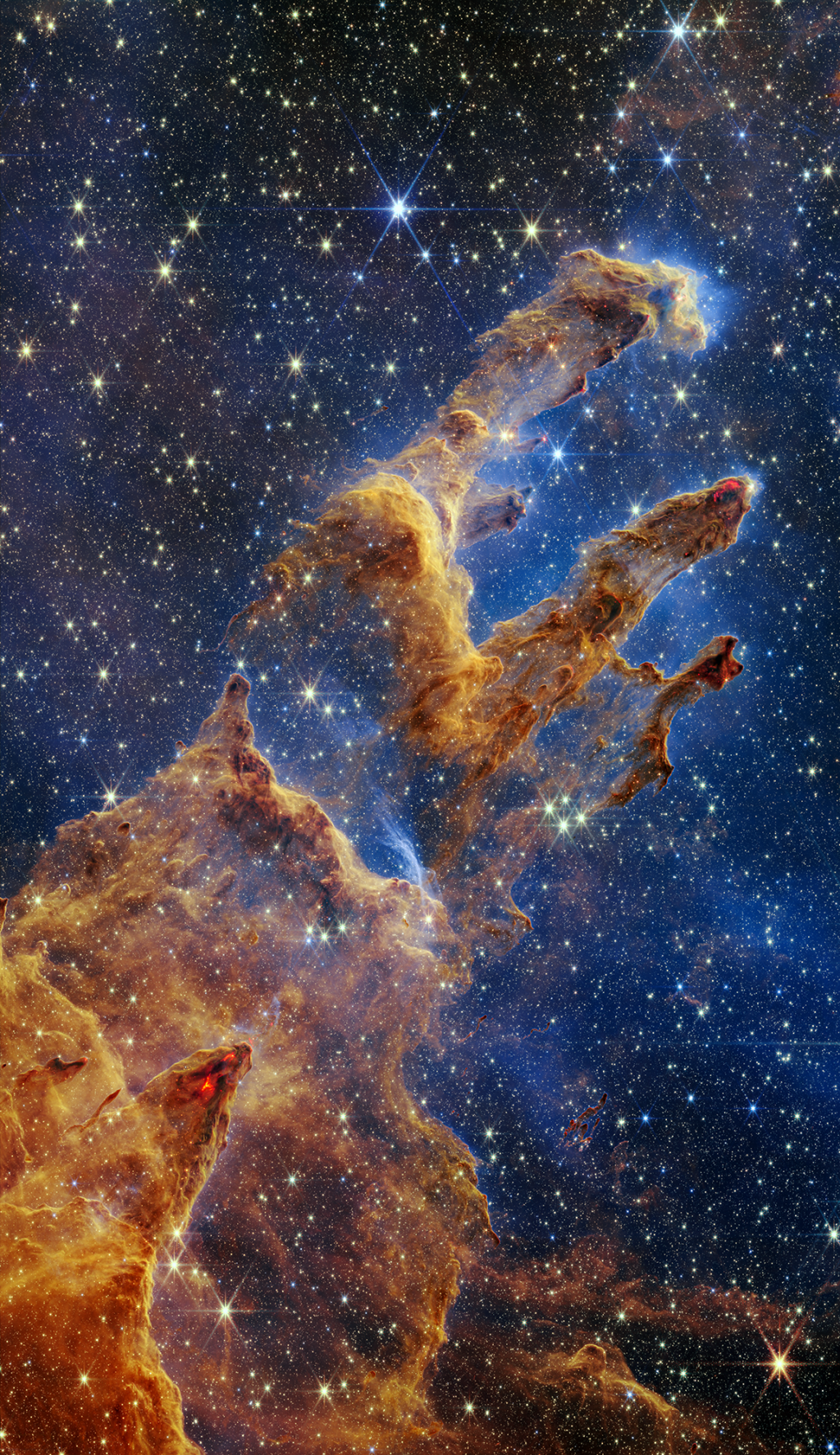
Photo: The Pillars of Creation, taken by NASA’s James Webb Space Telescope
Photo Credits: NASA, ESA, CSA, STScI; Joseph DePasquale (STScI), Anton M. Koekemoer (STScI), Alyssa Pagan (STScI).
Citations:
- NASA Town Hall June 25, 2025.
- Dreier, Casey. “NASA’s Disastrous 2026 Budget Proposal in Seven Charts.” The Planetary Society, June 2025.
- Foust, Jeff. “White House Proposal Would Slash NASA Science Budget and Cancel Major Missions.” SpaceNews, 11 Apr. 2025,
- David, Leonard. “Trump’s 2026 Budget Plan Would Cancel NASA’s Mars Sample Return Mission. Experts Say That’s a ‘Major Step Back.’” Space.com, 13 May 2025,
- RTI International. “New Report Reveals Economic Benefits from Private Sector Use of GPS.” RTI International, 6 June 2019.
 Casey Moeckel
Leave a comment